.svg)
subdirectory_arrow_right

Alexander Flake
CEO + Co-founder of Patentext
Alex is the co-founder and CEO of Patentext. He’s spent over a decade drafting patents for startups, unicorns like Uber and Dropbox, and everything in between. When he’s not obsessing over Patentext or running his climate tech-focused IP firm, he’s likely training for a triathlon or chasing a very fast border collie.
Legal work is one of those startup costs that scales awkwardly. With law firms charging hundreds of dollars an hour, most founders end up handling what they can themselves and paying only for the most high-stakes work.
AI tooling is starting to change that calculus by compressing the time and cost of routine work, including first-pass contract review, NDA generation, trademark screening, and compliance monitoring. These are the kinds of tasks that don't require strategic judgment but still eat hours and budget.
The challenge is that "AI legal tools" have become a crowded category, and the quality varies enormously. Some products deliver real efficiency gains; others are ChatGPT wrappers with a legal skin. Knowing which tools actually work and where they fit in a startup's workflow takes more diligence than most founders have time for.
We’ve got you covered. Here's a breakdown of all the AI legal tools worth considering across contracts, IP, compliance, and general legal operations.
AI legal tools for startups: common categories
Before diving into specific products, it helps to understand how the landscape breaks down:
- Intellectual property: Tools for patent drafting, trademark search, prior art analysis, and portfolio management. This category varies widely in sophistication, with some tools assisting only with preliminary research while others aim to automate substantial portions of the drafting process itself.
- Contract review and analysis: Tools that ingest contracts and flag risks, missing clauses, or nonstandard terms. These are useful for reviewing inbound agreements (vendor contracts, partnership deals, investment docs) without burning hours or outside counsel fees on first-pass work.
- Contract generation and management: Tools that draft, templatize, and track agreements. These range from simple NDA generators to full CLM (contract lifecycle management) platforms that handle version control, approvals, and signature workflows.
- Compliance and regulatory: Tools that monitor regulatory obligations, track policy changes, and flag potential issues before they become problems. These are particularly relevant for startups in regulated industries (fintech, healthtech, etc.) or those expanding into new jurisdictions.
AI patent and intellectual property tools for startups
For most startups, patent work is too important to ignore, yet too expensive to do properly and too specialized to DIY. The tools in this category aim to close that gap by helping founders capture, structure, and protect inventions without burning runway on traditional law firm rates.
Patentext
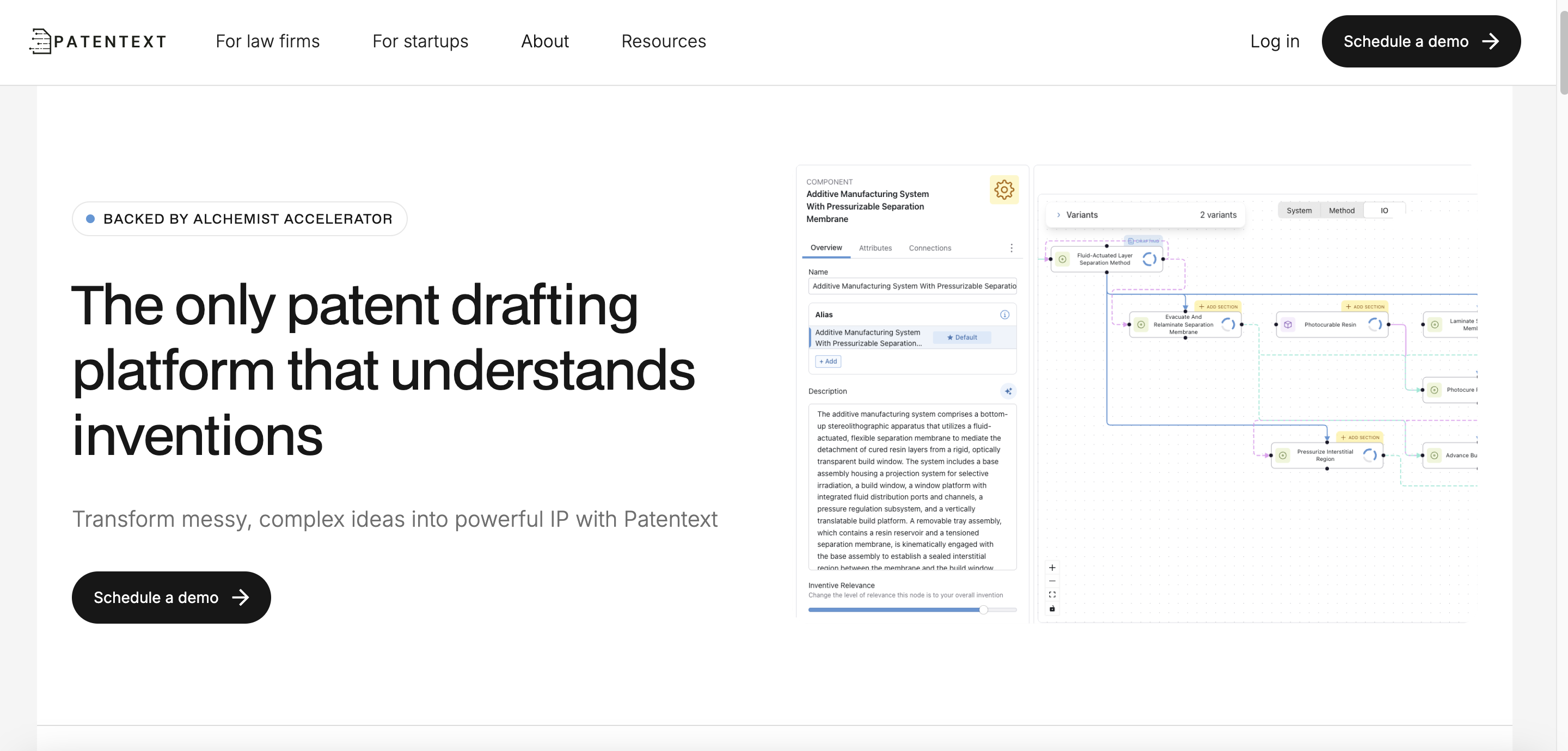
Patentext is an AI-powered patent drafting platform built around an Invention Graph: a structured, visual representation of your invention's components, relationships, and logic. Rather than generating text from vague prompts, the platform first maps out what you're actually building, then uses that structure to produce draft language that holds together.
For startups specifically, Patentext is launching a new product called Patentext Origin (currently waitlist-only). Origin is designed to capture inventions as they form, help founders build patent strategies, and connect you with patent professionals who can file your Patentext-generated applications.
- Platform type: All-in-one patent tool for startups
- Best for: Early-stage technical teams who want to build IP discipline into their workflow without hiring in-house counsel or spending $20k+ per filing at a traditional firm. Particularly relevant for startups where the founders are also the inventors.
- What makes it different: Patentext Origin supports the full arc from invention capture through draft generation, with filing completed in collaboration with patent professionals. Other patent drafting tools currently on the market cover only one piece or are designed for patent attorneys and agents who already know what a claim set should look like.
- Cons: Origin is currently waitlist-only, so access is limited.
Join the Patentext Origin waitlist to get 20% off when it launches.
Trademarkia.ai
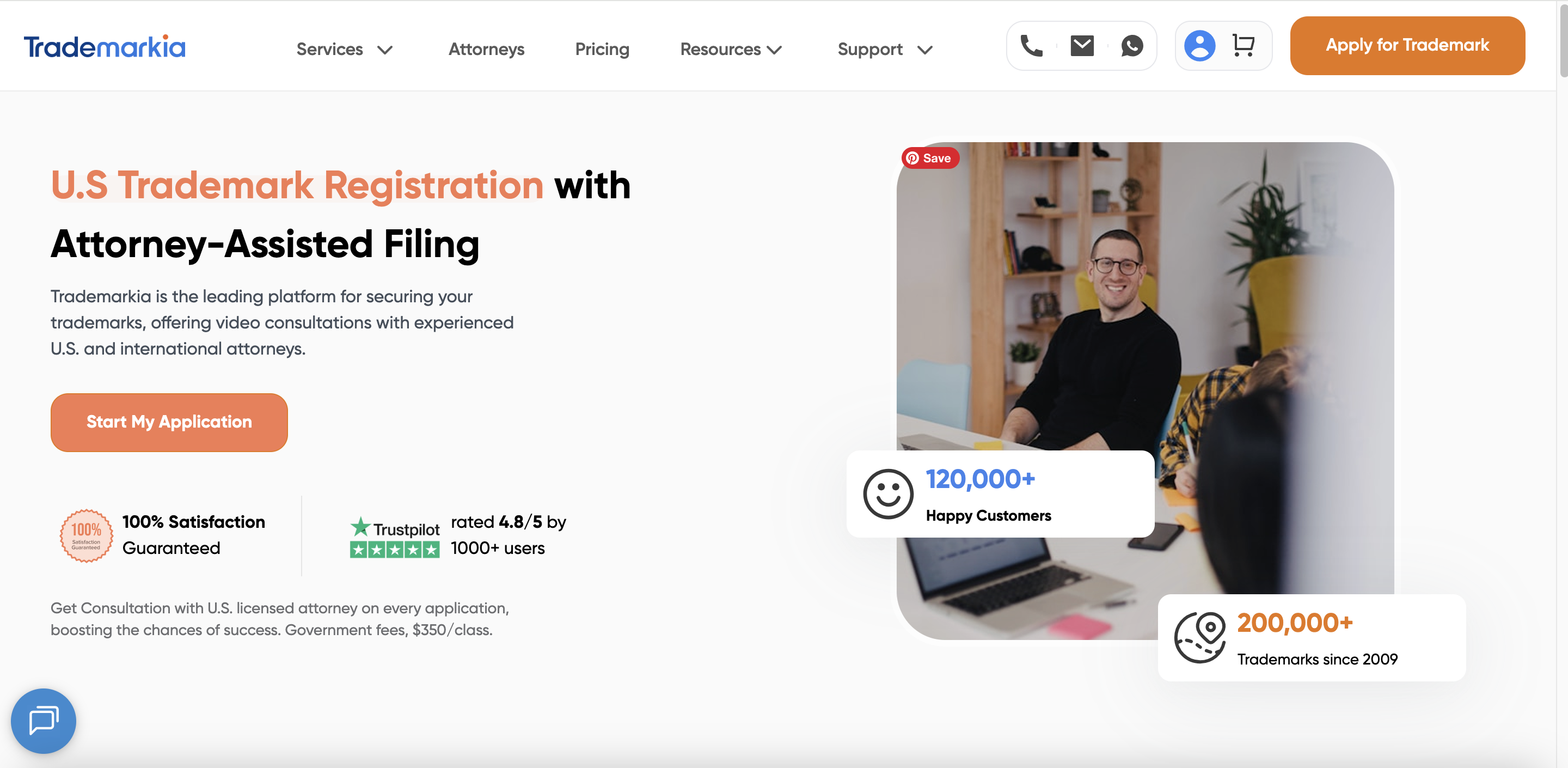
Trademarkia.ai is the AI-focused arm of Trademarkia, one of the largest trademark search platforms in the U.S. The tool uses machine learning to help founders quickly assess whether a proposed brand name or logo is likely to run into conflicts and whether it has a realistic shot at registration.
The core offering is a registrability predictor: you enter a proposed mark, and the system analyzes it against USPTO filings to estimate your chances of successful registration. It also generates comparison reports between your mark and similar existing trademarks, flagging potential conflicts before you invest in branding, packaging, or a full legal search.
- Platform type: AI-powered trademark search and registrability analysis
- Best for: Startups in the early stages of brand development who want to screen multiple name options before engaging a trademark attorney.
- What makes it different: Most trademark search tools return a list of similar marks and leave interpretation to you (or your attorney). Trademarkia.ai adds a predictive layer, giving you a probability score and AI-generated analysis of where conflicts might arise.
- Cons: The predictive scores are helpful for screening, but shouldn't replace a comprehensive clearance search for marks you're serious about.
Tangibly
Tangibly is an AI-powered platform for identifying, cataloging, and managing trade secrets. For startups, trade secrets can include everything from proprietary algorithms and training data to customer lists, pricing models, and manufacturing processes.
The platform helps companies document what qualifies as a trade secret, track who has access, manage NDAs and confidentiality agreements, and build the kind of paper trail that matters if you ever need to enforce your rights. Tangibly also offers a "Patent X-Ray" tool that uses AI to analyze your existing patents and surface potential trade secrets you may have overlooked, essentially helping you identify valuable IP that might be better protected through secrecy than disclosure.
- Platform type: AI-powered trade secret identification and management
- Best for: Startups with proprietary technology, processes, or data that may be better suited for trade secret protection than patents, particularly AI/ML companies, and SaaS platforms.
- What makes it different: Most IP tools focus on patents or trademarks; Tangibly is built entirely around trade secrets, which is a category most startups protect informally (NDAs in a folder somewhere) or not at all.
- Cons: Trade secret management is an ongoing discipline, not a one-time filing. The platform is most valuable if you commit to using it consistently. Pricing is custom-quoted and may be more enterprise-oriented than some early-stage startups need.
AI contract drafting, review, and analysis tools for startups
Contracts (including NDAs with potential hires, vendor agreements, partnership terms, and investment docs) are the connective tissue of any startup. But reviewing them properly takes time most founders don't have, and outside counsel bills add up fast when you're sending redlines back and forth on a standard services agreement.
AI contract tools have matured significantly over the past two years. The best ones can now flag risky clauses, identify missing terms, compare language against market standards, and suggest redlines, all of which are tasks that used to require a junior associate or expensive outside review. For startups, this means faster turnaround on routine agreements and fewer situations where you sign something problematic because no one had time to read it carefully.
Spellbook
Spellbook is an AI-powered contract drafting and review tool that lives inside Microsoft Word and works as a sidebar to flag risks, suggest alternative language, and answer questions about the contract you're working on.
The tool uses OpenAI's latest models but is trained specifically on legal language and contract structures. In practice, this means it can identify problematic clauses (one-sided indemnification, aggressive IP assignment, unusual termination terms), suggest redlines based on your position, and catch missing provisions that should be there but aren't. A recent feature, Preference Learning, lets the system adapt to your firm's or company's standard positions over time.
- Platform type: AI-powered contract review and drafting assistant; Word integration
- Best for: Founders reviewing inbound contracts who want a second set of eyes without paying associate rates. Also useful for small legal teams handling high volumes of routine agreements.
- What makes it different: Spellbook grounds its suggestions in actual contract data rather than generating language from scratch, which reduces the hallucination risk that plagues general-purpose AI when applied to legal work.
- Cons: Requires Microsoft Word, so if your workflow is Google Docs-native, it won't fit. The tool is stronger on review than on drafting complex agreements from scratch. Pricing (~$40-179/user/month, depending on plan) may be steep for very early-stage startups that only review a handful of contracts per month.
Ironclad
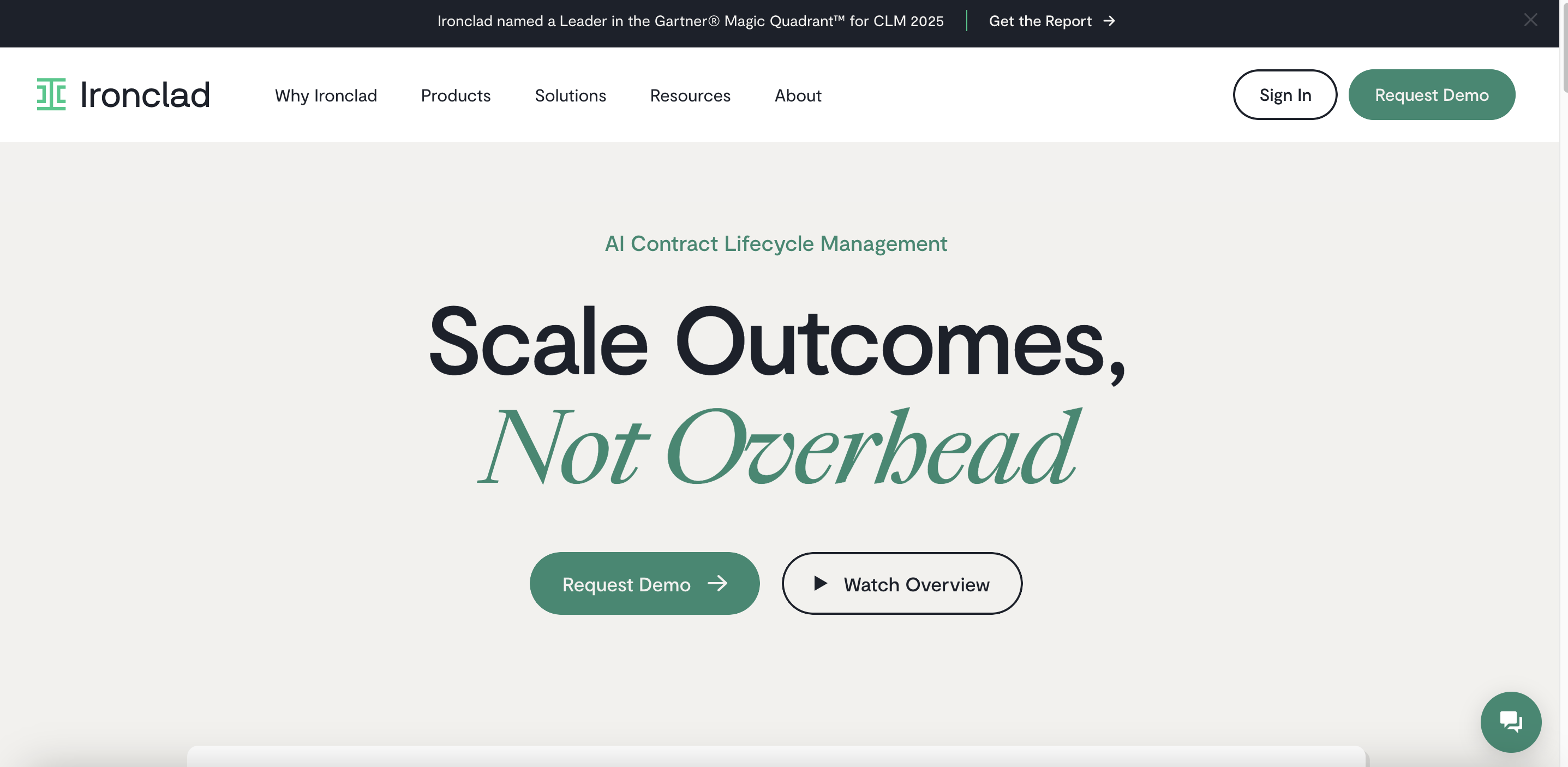
Ironclad is a full contract lifecycle management (CLM) platform with AI baked into every stage, from initial drafting through signature, storage, and obligation tracking. Unlike point solutions that focus on review or drafting alone, Ironclad is designed to be the system of record for all your contracts, with workflow automation that routes agreements through approvals, tracks versions, and ensures nothing falls through the cracks.
The platform's AI capabilities include clause detection, automated tagging, and risk identification across your entire contract repository. In 2024, Ironclad introduced Jurist, a conversational AI assistant that can answer questions about your contracts, surface relevant clauses across documents, and help with research, essentially letting you query your contract database in natural language.
- Platform type: AI-powered contract lifecycle management (CLM) platform
- Best for: Startups that have outgrown ad hoc contract management and need a centralized system; typically Series B and beyond. Also a strong fit for teams where legal, sales, and ops all touch contracts and need visibility into status and terms.
- What makes it different: The platform connects contracts to the rest of your business through integrations with Salesforce, HubSpot, and other CRM/ERP systems, so sales contracts flow automatically into the right workflows without manual handoffs. For companies where contracts are a bottleneck, this orchestration layer is where the real efficiency gains come from.
- Cons: Ironclad is built for scale, and the pricing reflects that. Implementations typically run $25,000-$120,000+ annually, depending on team size and features, with enterprise deployments exceeding $150,000. Setup requires real investment in configuration and workflow design, which is overkill for early-stage startups managing a few dozen contracts per year.
Juro
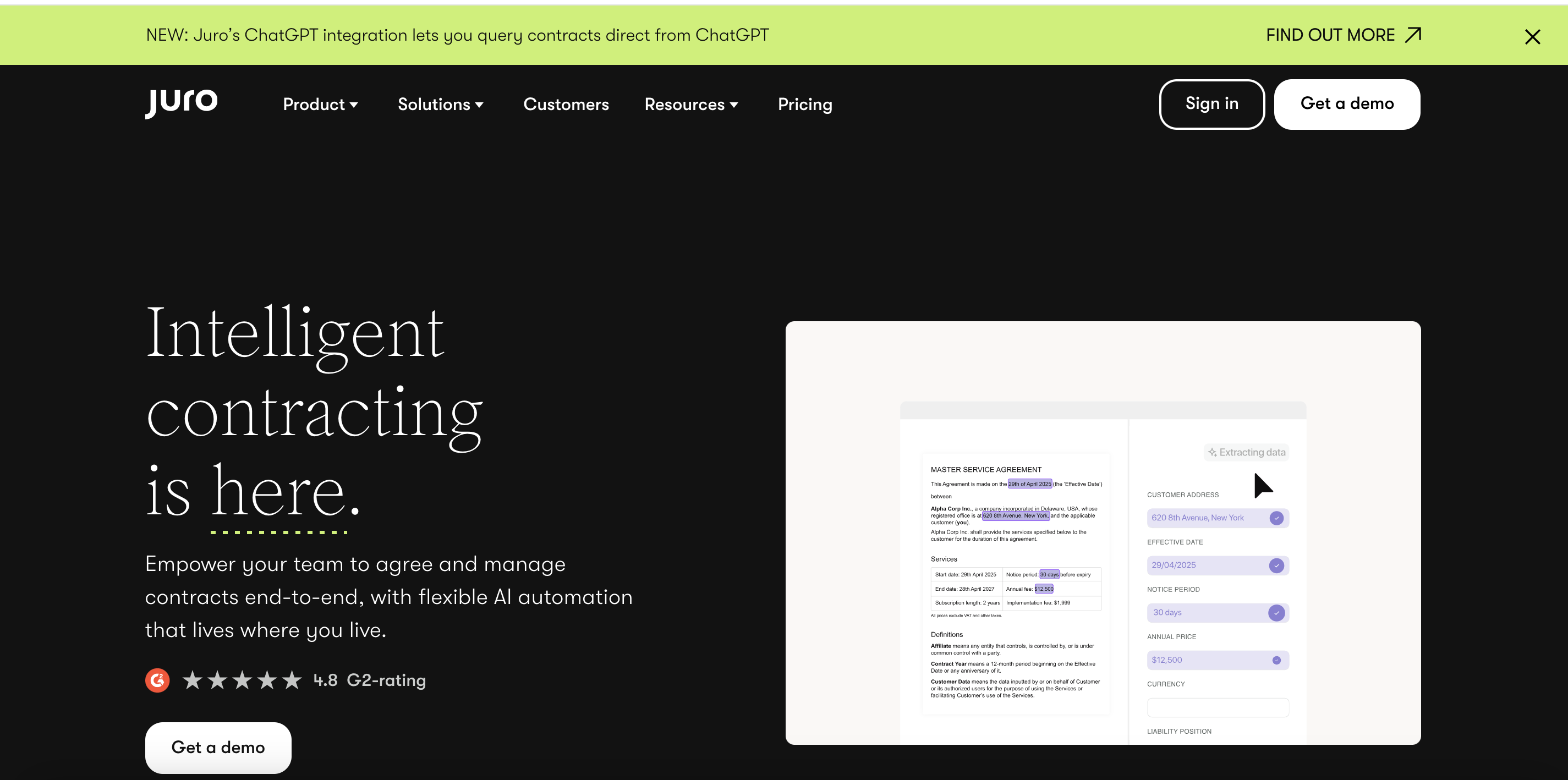
Juro is an all-in-one contract platform built for speed and collaboration, particularly between legal and business teams. The interface is browser-native, which makes real-time collaboration, commenting, and redlining feel more like working in Notion or Google Docs than traditional legal software.
The platform covers the full contract workflow: template creation, automated drafting, approval routing, negotiation, e-signature, and storage. AI features assist with contract review, risk flagging, and data extraction, though Juro's primary value proposition is reducing friction in the contracting process rather than deep AI-powered analysis. The system can auto-populate contracts from CRM data, enforce pre-approved fallback language during negotiations, and track key terms across your repository.
- Platform type: Collaborative contract management platform with AI-assisted review
- Best for: Startups with high-velocity sales cycles who need to get contracts out the door without creating a legal bottleneck. Particularly well-suited for SaaS companies, marketplaces, and other businesses where commercial contracts are relatively standardized but volume is high.
- What makes it different: Both sides can redline in real-time (more like Google Docs than tracked changes), which compresses the back-and-forth that bogs down most contract workflows.
- Cons: The AI capabilities are less advanced than dedicated review tools; Juro is stronger on workflow and collaboration than on deep contract analysis. Pricing is competitive for the category but still requires a budget commitment (custom quotes, typically mid-market pricing).
Lexion
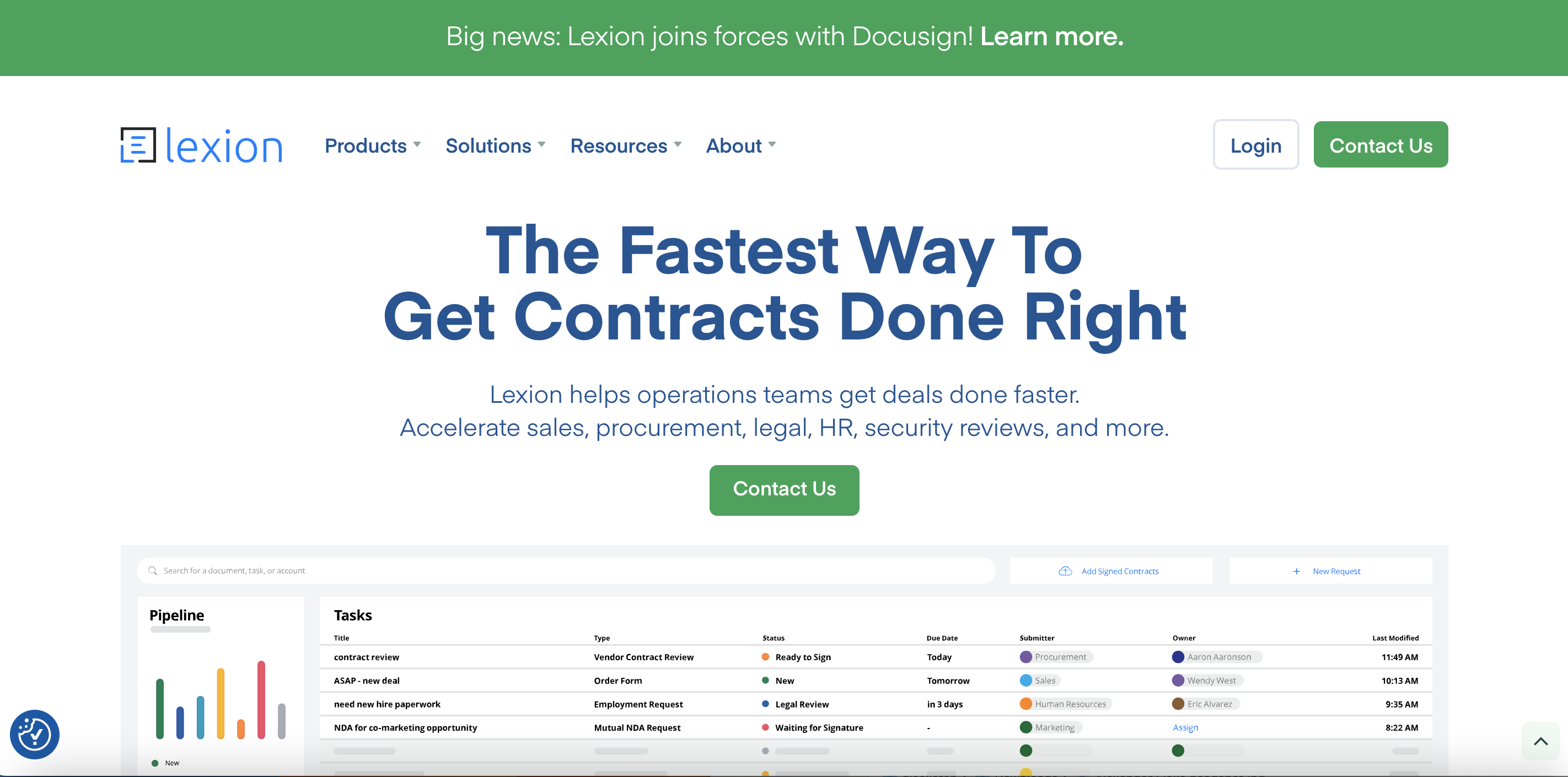
Lexion is an AI-powered contract management platform built at Paul Allen's AI research institute (AI2), with a focus on making adoption painless. Acquired by Docusign in 2024, the standout feature is email-driven intake: anyone in the company can send a contract to a designated address, and Lexion automatically creates a task, extracts key terms, and routes it through your workflow.
The platform covers the full contract lifecycle (including intake, review, approval routing, signature, and repository management) with AI that automatically extracts and indexes key data points like renewal dates, termination clauses, and obligations.
Lexion also offers AI Contract Assist, a GPT-powered copilot that works inside Microsoft Word to accelerate redlining and review. The system learns your playbook over time and can take a first pass at reviewing contracts based on your preferred positions.
- Platform type: AI-powered contract lifecycle management with email-driven workflow
- Best for: Mid-stage startups (Series A-C) where the legal team is small but contract volume is growing. Particularly strong for companies where contracts come in from multiple directions (e.g., sales, procurement, partnerships) and need to be centralized without forcing workflow changes on every team.
- What makes it different: Lexion’s "meet people where they are" approach tends to drive higher adoption rates than platforms that require everyone to log into a new tool. The AI extraction is also notably accurate out of the box, with less manual correction needed than some competitors.
- Cons: The platform is stronger on post-signature contract management (repository, tracking, obligations) than on pre-signature drafting and negotiation, though AI Contract Assist is closing that gap. Pricing is custom-quoted; expect mid-market rates that may be a stretch for very early-stage startups.
LegalOn
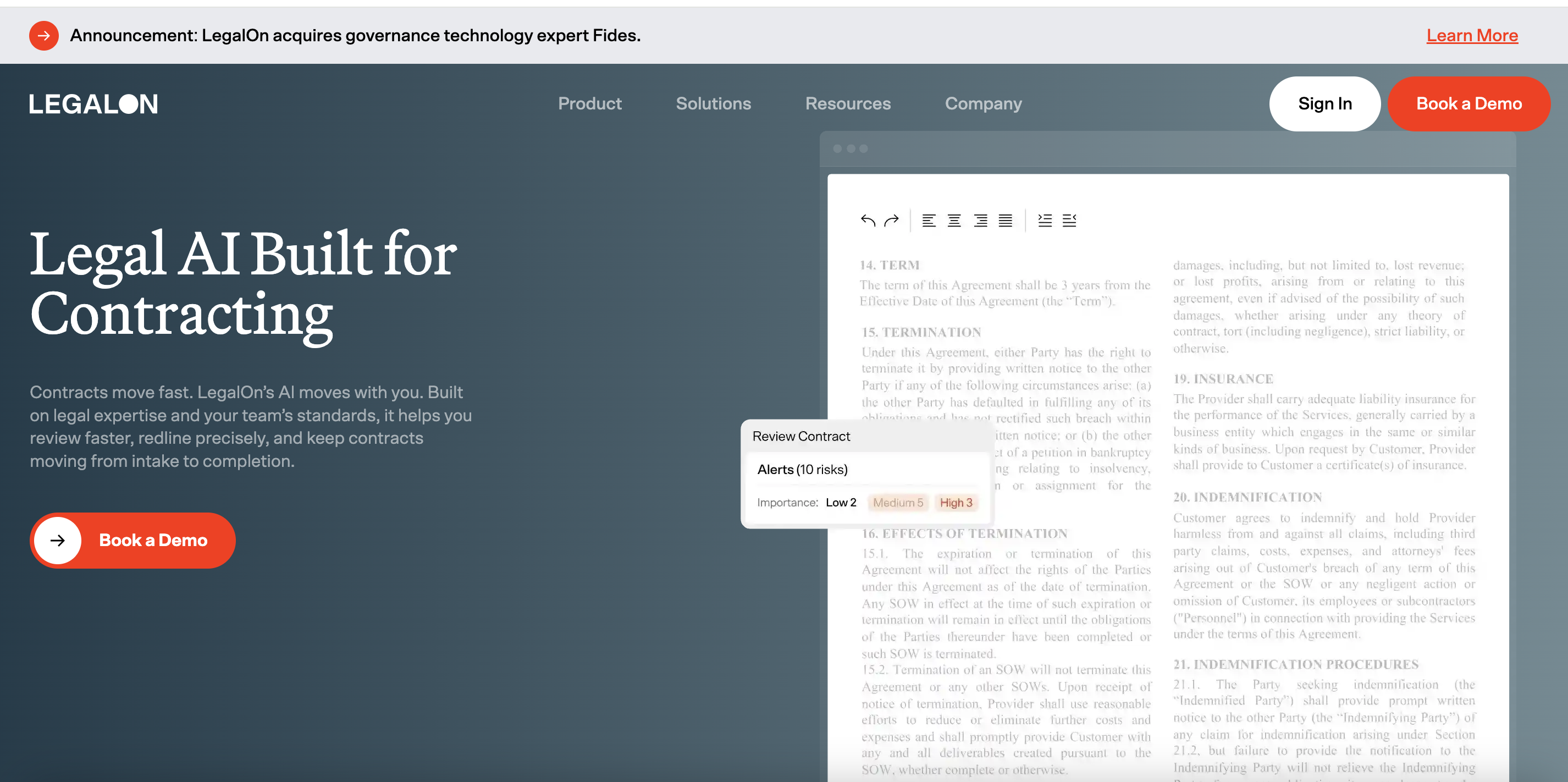
LegalOn is an AI contract review platform built around attorney-drafted playbooks. Upload a contract, and LegalOn flags risks, suggests redlines, and explains why specific clauses matter. The platform comes with 50+ playbooks covering common contract types (NDAs, MSAs, DPAs, vendor agreements), so you're not starting from scratch or training the system on your preferences.
Notably, LegalOn is more opinionated out of the box. Instead of an AI assistant that helps you draft and review, it's closer to having a checklist built by experienced attorneys that the AI applies automatically. You can customize playbooks to match your standards, but the defaults are designed to work on day one.
- Platform type: AI contract review with pre-built attorney playbooks
- Best for: Startups reviewing inbound contracts who want a consistent, attorney-informed review without building their own playbooks from scratch. Particularly useful when multiple people review contracts, and you need standardization.
- What makes it different: Pre-built playbooks mean you're not teaching the AI what to look for. The platform is designed around the idea that most contract review follows predictable patterns, and the AI should encode that expertise rather than learn it from each user.
- Cons: Works in Microsoft Word, so browser-native teams may find the workflow clunky. It’s also less flexible than Spellbook if you want an AI that adapts to your specific style.
AI compliance, risk, and regulatory tools for startups
Compliance used to be something startups worried about after the Series B or the enterprise sales motion. However, that timeline has compressed dramatically. Today, even seed-stage companies selling to mid-market customers get asked for SOC 2 reports, and healthcare or fintech startups face regulatory requirements from day one.
Unsurprisingly, a new generation of tools has emerged to automate the process: continuous monitoring of your infrastructure, automated evidence collection, policy generation, and streamlined audit prep. While these tools won't eliminate the work entirely, they dramatically reduce the operational overhead.
Vanta
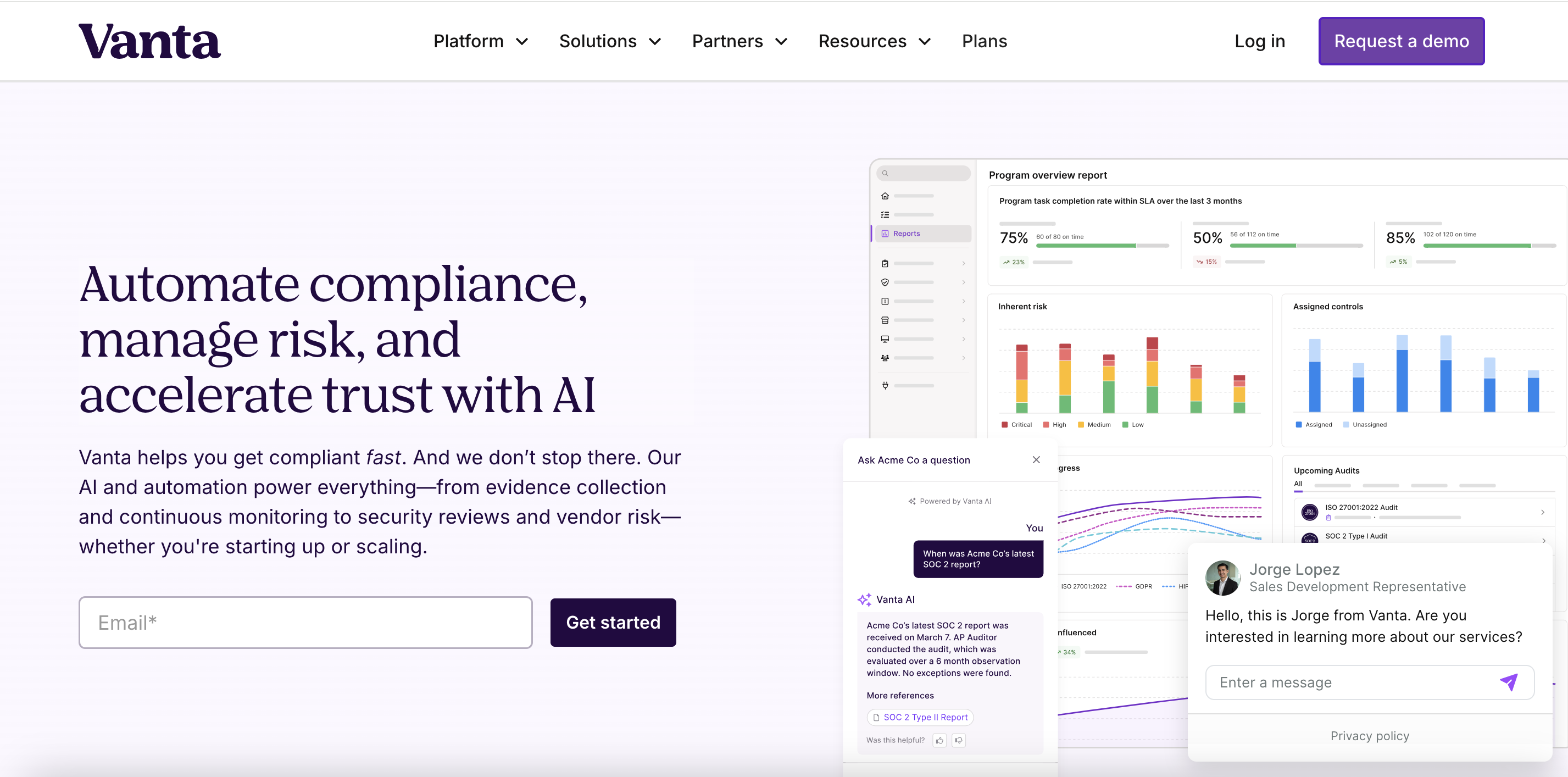
Vanta is the compliance automation platform that's become nearly the default for venture-backed startups pursuing SOC 2, ISO 27001, HIPAA, and other security certifications. The platform connects to your infrastructure (AWS, GCP, Azure), identity providers, HR systems, and other tools to continuously monitor your security posture and automatically collect the evidence auditors need.
Essentially, Vanta scans your environment, identifies gaps against your target framework, and tells you exactly what to fix. As you implement controls, the platform collects evidence automatically (e.g., screenshots of configurations, access logs, policy acknowledgments) so you're not scrambling to assemble documentation before an audit. When audit time comes, your auditor gets a pre-organized package rather than a folder of screenshots you pulled together the night before.
Vanta also includes AI features through Vanta AI, which can review vendor security documents, auto-complete security questionnaires, and surface relevant information from your compliance data. It's not the core value proposition, but it's a useful accelerant for teams drowning in questionnaires.
- Platform type: Continuous compliance monitoring and automation
- Best for: Startups pursuing SOC 2, ISO 27001, HIPAA, GDPR, or PCI DSS certification.
- What makes it different: Vanta's strength is coverage and integrations. With 300+ pre-built connections to common startup tools, the platform can monitor most of your stack out of the box.
- Cons: Vanta automates evidence collection and monitoring, but it doesn't implement controls for you. If your security posture has real gaps, the platform will surface them, but you'll still need to do the work to fix them. Pricing starts in the low five figures annually, which is meaningful for early-stage startups; the ROI math works best when you have enterprise deals that require certification.
Drata
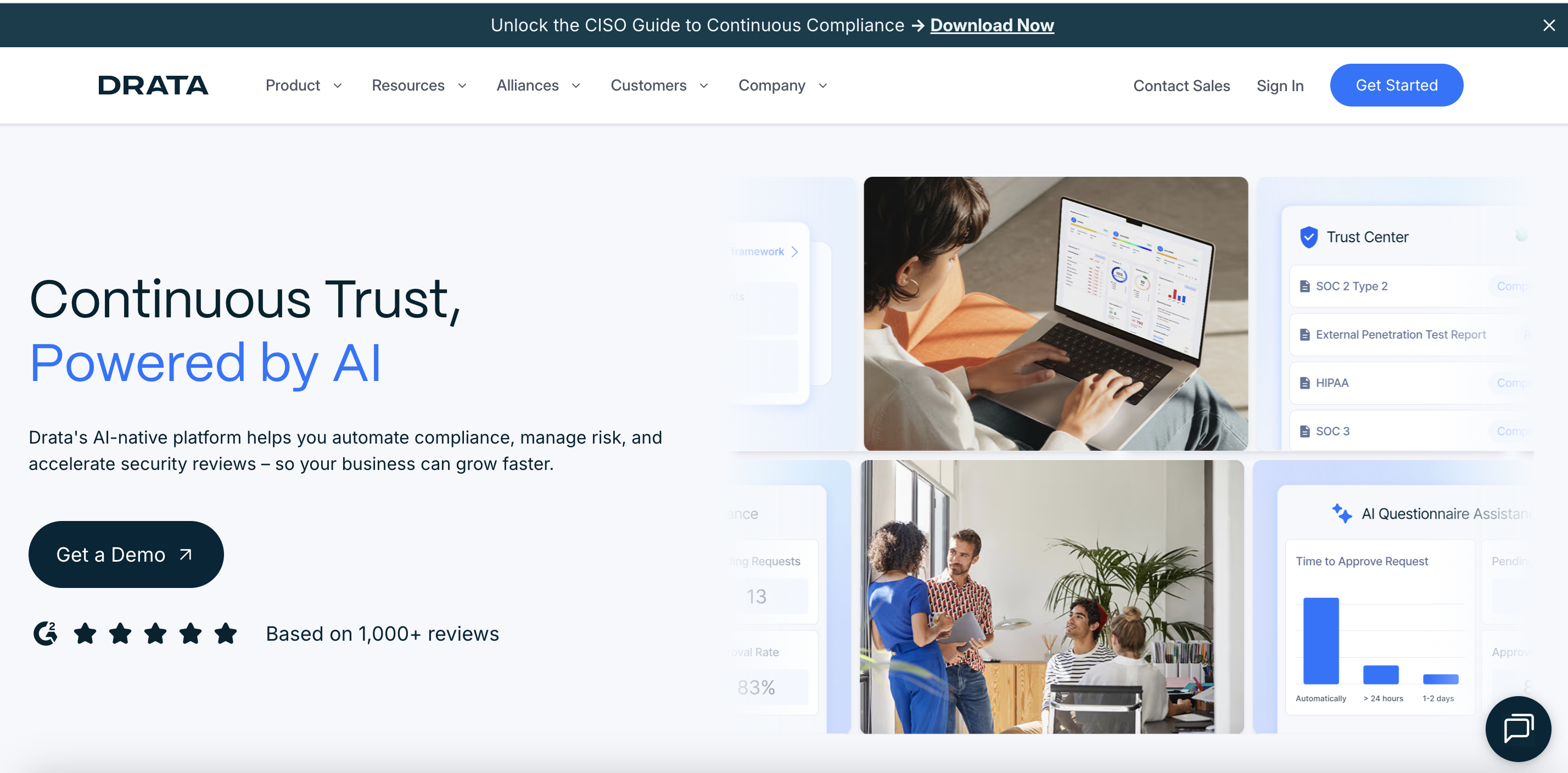
Drata is a compliance automation platform that competes directly with Vanta, offering continuous monitoring, automated evidence collection, and streamlined audit preparation across SOC 2, ISO 27001, HIPAA, GDPR, PCI DSS, and other frameworks.
The workflow is similar to other tools in the category: connect your systems, map controls to your target framework, remediate gaps, and let the platform collect evidence automatically. Where Drata has invested heavily is in the user experience. The dashboard is clean, the remediation guidance is specific, and the audit-readiness view gives you a clear picture of where you stand at any moment. The platform also supports custom frameworks, so if you have enterprise customers with proprietary security requirements, you can map those alongside your standard certifications.
- Platform type: AI-native continuous compliance automation
- Best for: Startups pursuing multiple certifications simultaneously or those with custom compliance requirements from large enterprise customers.
- What makes it different: Drata tends to win on polish and usability. The interface is more intuitive than some competitors, and the guided remediation reduces the expertise required to get compliant.
- Cons: Like Vanta, Drata automates the documentation and monitoring, not the underlying security work. The platform will tell you that you need endpoint management or access reviews, but you still have to implement those controls. Pricing is comparable to Vanta (low-to-mid five figures annually), so the same ROI considerations apply. Some users also report that the depth of integrations isn't quite as extensive as Vanta's for certain niche tools.
Sprinto
Sprinto is a compliance automation platform that has carved out a strong position with startups and SMBs who need to get certified without the enterprise price tag. The platform covers the major frameworks with the same core approach as Vanta and Drata: connect your systems, monitor continuously, collect evidence automatically, and streamline audit prep.
What sets Sprinto apart is the emphasis on speed and guided implementation. The platform is designed to take companies from zero to audit-ready as quickly as possible, with opinionated workflows that tell you exactly what to do next rather than presenting a sprawling list of controls to figure out on your own. Sprinto also includes built-in policy templates, employee training modules, and vendor risk management, which are features that some competitors charge extra for or leave you to handle separately.
- Platform type: Compliance automation with guided implementation
- Best for: Seed to Series A startups that need SOC 2 or ISO 27001 to close enterprise deals but don't have the budget for higher-priced platforms. Also popular with international startups (Sprinto has strong traction in India and Europe) and companies that want more implementation support rather than pure self-serve tooling.
- What makes it different: The platform also takes a more hands-on approach to implementation, with dedicated support that guides you through the process rather than leaving you to self-serve through documentation.
- Cons: The integration library isn't as extensive as Vanta's, so if you're using niche or less common tools, you may need to handle some evidence collection manually. The platform is optimized for speed to first certification, which is great for getting compliant, but some users find the ongoing compliance management features less mature than competitors.
Secureframe
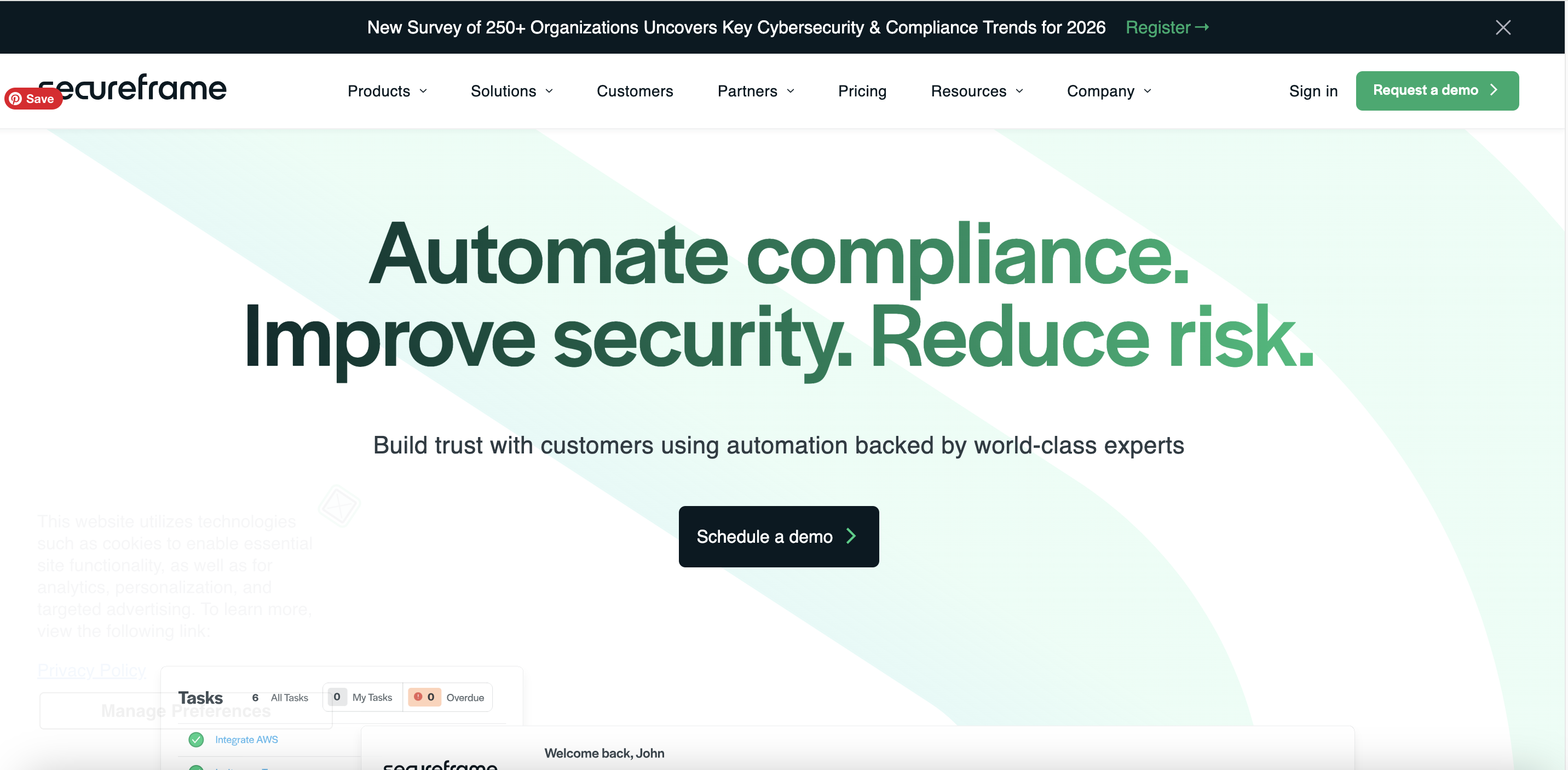
Secureframe is a compliance automation platform that emphasizes the combination of technology and expert guidance. Like its competitors, it covers the major frameworks with continuous monitoring, automated evidence collection, and streamlined audit prep.
The platform connects to over 100 integrations across cloud providers, identity management, HR systems, and developer tools to continuously monitor your security posture and collect audit evidence automatically. Secureframe also assigns a dedicated compliance expert to each customer, providing hands-on guidance from initial gap analysis through audit completion. This hybrid approach of automation plus expert support tends to resonate with teams that want the efficiency of software without feeling like they're navigating compliance alone.
- Platform type: AI-powered compliance automation with dedicated expert support
- Best for: Startups that want both automation and human expertise, particularly those pursuing multiple certifications or operating in industries with specialized compliance requirements (fintech, healthtech, govtech).
- What makes it different: Secureframe's strength is the combination of breadth and depth. The platform covers an unusually wide range of frameworks (including newer ones like CMMC 2.0 for government contractors and ISO 42001 for AI governance) while also providing dedicated expert support that goes beyond typical customer success.
- Cons: Pricing is in line with Vanta and Drata (mid-five figures annually), so the same budget considerations apply. The breadth of features can feel overwhelming for very early-stage companies with simple compliance needs.
How to evaluate AI legal tools
Most AI legal tools currently on the market were built for law firms or enterprise legal departments, then marketed to startups as an afterthought. So, before adopting anything, run it through a few filters.
Pricing transparency
If you can't find pricing on the website, the tool probably isn't designed for you. Enterprise sales processes like "book a demo," custom quotes, and annual contracts signal that the vendor expects customers with legal budgets and procurement teams.
Startups need tools with clear, published pricing and monthly billing options. A $500/month tool that you can cancel anytime is often better than a $3,000/year tool that requires a sales call and a 12-month commitment.
Control versus automation
Some tools want to take over entire workflows. Others give you leverage on specific tasks while keeping you in control. For startups without legal teams, full automation sounds appealing until you realize you can't evaluate whether the output is correct.
So, look for tools that show their work rather than just producing outputs. The goal is to do more with less, not to remove humans from decisions that could sink the company.
Explainability
When an AI flags a contract clause as "high risk" or suggests patent claim language, can you see why? Tools that provide reasoning and citations let you learn as you use them and catch errors before they matter. Black-box outputs are fine for low-stakes tasks but dangerous for legal work where context changes everything.
Whether the tool assumes a legal team exists
Many AI legal tools are designed to make lawyers more efficient, not to help non-lawyers navigate legal work. If the interface assumes you know what a "representations and warranties" section should contain, or that you can evaluate whether a patent claim has proper antecedent basis, it's built for professionals. The best startup tools either require no legal background or are explicit about when you need to bring in counsel.
Disclaimer: This article is for informational purposes only and does not constitute legal advice. Patent laws are complex and vary by jurisdiction. For personalized guidance, consult a qualified patent attorney or agent.