.svg)
subdirectory_arrow_right

Alexander Flake
CEO + Co-founder of Patentext
Alex is the co-founder and CEO of Patentext. He’s spent over a decade drafting patents for startups, unicorns like Uber and Dropbox, and everything in between. When he’s not obsessing over Patentext or running his climate tech-focused IP firm, he’s likely training for a triathlon or chasing a very fast border collie.
If you're comparing Solve Intelligence and &AI, you're probably asking one of two questions: "Which one should I use?" or "Do I need both?"
The honest answer is that these tools were built for different stages of the patent lifecycle. Solve Intelligence started as a patent drafting and prosecution platform, while &AI started as a patent litigation platform focused on claim charts and invalidity analysis. For most of their existence, they haven't competed at all.
That changed in December 2025, when Solve launched Charts, a claim charting and analysis product that moves directly into &AI's core territory. Now the question of whether to use one, both, or neither has gotten more complicated.
In this guide, we'll break down what each platform actually does, where they overlap and diverge, how pricing works, and who should use which.
Disclaimer: This guide is based on publicly available information, including company websites, published reviews, press coverage, investor materials, and product documentation. Features may have changed since this comparison was written.
Solve Intelligence vs. &AI: The core difference
Before diving into features, it's worth understanding why these tools exist in the first place.
Solve Intelligence was built to help patent attorneys draft applications faster. Over time, Solve expanded into prosecution (office action responses, amendments, case law citations), and more recently, into claim charting and portfolio analysis.
&AI was built to help patent litigators produce work product faster, specifically in terms of invalidating prior art, building claim charts, drafting invalidity contentions, or assessing infringement. The company has since added some prosecution features, but litigation remains the center of gravity.
This distinction matters because the skills these tools need are fundamentally different:
- Drafting requires synthesizing technical disclosures into legal language that will survive examination and enforcement. The AI needs to understand invention structure, claim construction, and how to build in fallback positions.
- Litigation analysis requires parsing existing patents against prior art or accused products. The AI needs to understand claim limitation mapping, prosecution history estoppel, and how to surface relevant evidence across massive document sets.
Both are hard problems. But they're different problems, which is why Solve and &AI evolved from opposite directions.
Solve Intelligence: An overview
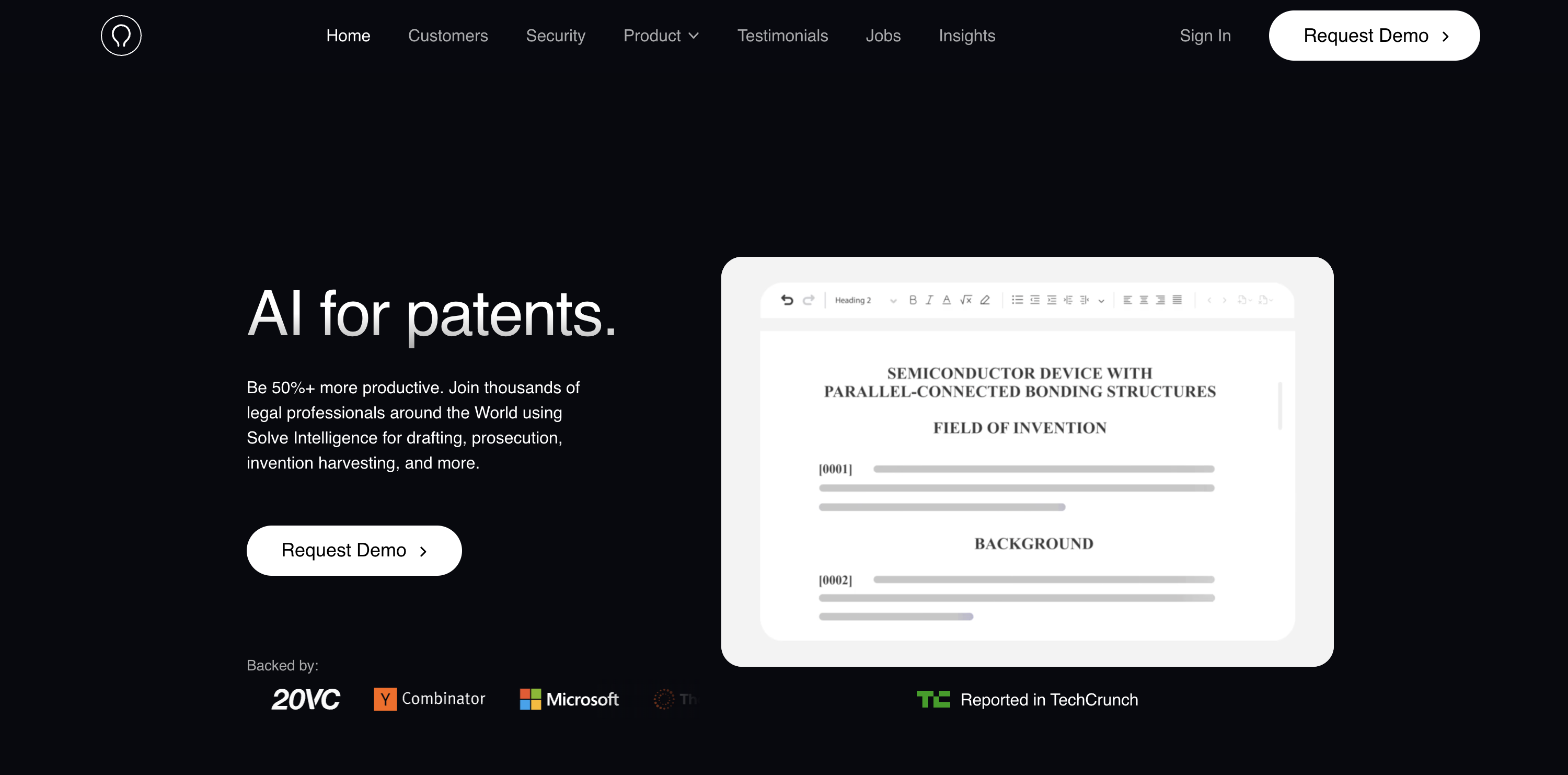
Solve Intelligence came out of Y Combinator's Summer 2023 batch and has raised aggressively since. The company closed a $3M seed round shortly after launch, followed by a $12M Series A in April 2025 (backed by Microsoft's M12 and Thomson Reuters Ventures), and a $40M Series B in December 2025.
The founding team includes Chris Parsonson, Sanj Ahilan, and Angus Parsonson, who all come from machine learning research rather than patent law. Chris and Sanj completed PhDs in machine learning at UCL, with prior experience at The Alan Turing Institute, Dyson, and Huawei.
That background shapes the product. Solve is built by AI researchers who saw patent drafting as ripe for automation and set out to build the most comprehensive toolset they could. The result is a platform that tries to cover the entire patent lifecycle: drafting, prosecution, invention harvesting, office action responses, and now claim charting.
Core capabilities:
- Full application drafting with jurisdiction-specific models (USPTO, EPO)
- Figure generation and editing from text prompts
- Office action response drafting with case law citations
- Invention disclosure management and inventor collaboration
- Claims Charts product (launched December 2025) for claim charting, invalidity, and SEP mapping
- Style adaptation to match your firm's drafting preferences
- ISO 42001 and SOC 2 certified
&AI: An overview
&AI is newer and has taken a different path. Founded in 2024 by Caleb Harris and Herbert Turner — both MIT-trained engineers with backgrounds in technical consulting for patent litigation at Fish & Richardson and Gibson Dunn — the company raised a $6.5M seed round in February 2025.
Where Solve started with drafting and expanded outward, &AI started with litigation work product and treats prosecution as secondary. The platform is built around a global patent corpus (1B+ vectors, 250B tokens of data) and an AI agent called "Andy" that can automate multi-step litigation workflows.
Core capabilities:
- Prior art search across global patent databases and non-patent literature
- Invalidity and evidence-of-use claim charts generated in minutes (not hours)
- Claim constructions from prosecution history, as-filed applications, and patent families
- Draft invalidity contentions, expert reports, and pitch materials
- AI agent "Andy" that plans and executes complex litigation workflows
- Real-time product and non-patent literature search for infringement analysis
- SOC 2 certified
Solve Intelligence vs. &AI: Where they overlap
The most direct competition between Solve Intelligence and &AI is now in claim charting.
&AI has offered claim charting since launch. It's their core strength, with customers reporting 70-90% time savings on building claim charts compared to manual workflows. The platform maps claim limitations against prior art or accused products, surfaces relevant evidence, and exports litigation-ready charts.
Solve Intelligence launched Charts in December 2025 as part of their Series B announcement. The product supports claim charting, invalidity analysis, freedom-to-operate, and SEP mapping. It's designed to integrate with Solve's existing drafting and prosecution tools, so applications created in Solve are already structured for downstream analysis.
Is Solve's Charts product good enough to replace &AI?
Based on what's publicly available, here's our read:
- &AI is purpose-built for litigation: The entire platform is organized around the workflows litigators actually need: fast prior art surfacing, claim limitation mapping, and document generation for court. The AI agent "Andy" can automate multi-step tasks (run a search, build a chart, draft contentions) without manual intervention between steps.
- Solve Charts is an extension of a prosecution platform: It's designed to connect drafting to enforcement, which makes sense for firms that want lifecycle continuity. But litigation isn't Solve's origin story, and the product is newer.
If your primary need is litigation-grade claim charts for active matters, &AI has more runway and focus in that space. If you're already using Solve for drafting and want claim charting integrated into your existing workflow, Solve Charts may be sufficient, especially for FTO and clearance work that doesn't require the same rigor as litigation.
Solve Intelligence vs. &AI: Core feature comparison
Patent drafting
Solve Intelligence uses a chat-based, in-browser editor. You upload a disclosure, and the AI helps you draft section by section using prompts like "rewrite this claim," "expand this embodiment," or "add a paragraph on the control system." The platform supports standalone applications, continuations, divisionals, and CIPs, with templates for USPTO and EPO.
This approach gives practitioners control over where the AI steps in. You can use Solve lightly (occasional paragraph generation) or heavily (full application drafts). But output quality depends on how well you prompt. Experienced users develop internal playbooks; new users face a learning curve.
&AI does not offer full application drafting. The platform includes some office action response capability, but prosecution is not the focus. If you need to create patent applications from scratch, &AI won't help.
Claim charting and invalidity
Solve Intelligence Charts offers claim charting for FTO, clearance, infringement, and invalidity. The product integrates with Solve's drafting tools, so applications you create are already structured for analysis. But it's a newer product, and the litigation-specific features (contentions drafting, pitch materials) are less developed than &AI's.
&AI, on the other hand, is built for this. The platform searches across 1B+ vectors of global patent data, maps claim limitations against prior art or products, and generates invalidity or evidence-of-use charts in minutes. It also drafts invalidity contentions and expert reports grounded in the analysis.
Prosecution and office actions
Solve Intelligence has invested heavily here. The platform analyzes office actions, suggests amendments, generates response shells, and cites relevant case law. This is one of Solve's strongest areas.
&AI includes office action response capability, but it's not the primary focus. The platform can help with responses using technical context and client goals, but prosecution is secondary to litigation.
Prior art search
Solve Intelligence includes prior art search as part of the prosecution workflow, but it's not as central to the platform as it is for &AI. For litigation-grade prior art work, &AI has more depth.
&AI conducts comprehensive prior art searches across global patent databases and non-patent literature. The system uses semantic search (not just keyword matching) to surface relevant references, which is critical for invalidity analysis.
Solve Intelligence vs. &AI: Feature comparison table
A checkmark (✓) means the feature is available. A dash (—) means the feature is not currently offered or not publicly confirmed.
Solve Intelligence vs. &AI: Pricing
Neither Solve Intelligence nor &AI publishes pricing prominently on their websites, but we can piece together their pricing based on publicly available information.
Solve Intelligence pricing
Solve Intelligence doesn't list pricing on their website, but we can estimate. A NAPP member discount offers 15% off annual subscriptions, valued at ~$1,400, which suggests a full-price annual subscription around $9,300/user/year (~$775/month).
Solve uses a strictly per-seat model, so costs scale with team size regardless of output volume.
&AI pricing
&AI uses custom pricing that's reportedly influenced by volume (e.g., the number of claim charts generated or litigation matters handled) rather than just seat count. Early customers report using the platform for thousands of claim charts, suggesting the model is designed to scale with actual usage rather than headcount.
Solve Intelligence vs. &AI: What each tool gets wrong
Solve Intelligence
- Prompt dependency is real: Solve's flexibility is also its main liability. Output quality varies significantly depending on how you phrase requests. Experienced users develop internal playbooks, but that's work you have to do yourself.
- Feature density can overwhelm: Solve covers drafting, prosecution, invention harvesting, office actions, and now claim charting. For large firms with dedicated teams, this breadth is valuable. For smaller practices, it can feel like paying for a Swiss Army knife when you needed a scalpel.
- Charts is new: Solve launched their claim charting product in December 2025. It integrates well with their prosecution tools, but it doesn't have the same depth or litigation focus as &AI. If you're buying Solve specifically for claim charting, you're betting on a newer product.
- Mechanical and hardware inventions require more effort: User reviews note that Solve performs best on software and computer-implemented inventions. Mechanical patents, medical devices, and chemistry-heavy applications require more iteration.
&AI
- It's not a drafting tool: If you need to create patent applications from scratch, &AI won't help. The platform assumes you already have patents to analyze, not inventions to protect. For prosecution-heavy practices, this is a fundamental limitation.
- Prosecution features are secondary: &AI includes office action support, but it's not the focus. If you need deep prosecution capability (invention disclosure management, jurisdiction-specific drafting, figure generation), you'll need a separate tool.
- Agent-based automation is new territory: "Andy" can automate complex workflows, but AI agents are an emerging technology. Some users find the automation helpful; others prefer more manual control. Your mileage may vary.
Solve Intelligence vs. &AI: Who should use which tool
Choose Solve Intelligence if:
- You need a comprehensive prosecution platform: Solve covers drafting, office actions, invention disclosure, and now claim charting. If you want one system for everything that touches a patent application, Solve offers that.
- You value customization and control: Solve's chat-based interface lets you direct exactly where the AI contributes. If you've developed strong drafting instincts and want an AI that adapts to your process, Solve offers flexibility.
- You're primarily drafting software patents: User feedback suggests Solve performs best on software and computer-implemented inventions. If that's your docket, you'll get stronger results.
- You have enterprise budget and bandwidth: Solve is a feature-rich platform that takes time to learn. Smaller teams may find themselves paying for features they don't need.
Choose &AI if:
- You need litigation-ready work product fast: &AI is built for claim charts, invalidity contentions, and prior art search at litigation speed. If you're building charts for active matters or evaluating patents for IPR, &AI is purpose-built for that.
- You want AI agent automation: Andy can execute multi-step workflows without manual intervention. If you're doing repetitive analysis across large document sets, this saves significant time.
- You're primarily a litigation practice: If most of your patent work is enforcement, defense, or licensing rather than prosecution, &AI aligns with how you actually spend your time.
- Prior art search is critical to your workflow: &AI's semantic search across 1B+ vectors identifies references that keyword searches miss. For invalidity and FTO analysis, this depth matters.
The case for Patentext + &AI
Here's the question neither vendor will ask you: Do you actually need an all-in-one platform?
Solve Intelligence's pitch is comprehensive coverage, with drafting, prosecution, and now litigation analysis in one system. That makes sense for large firms standardizing on a single platform. But it also means paying for (and learning) features you may not need, navigating enterprise sales cycles, and betting on a single vendor across your entire workflow.
Use Patentext for drafting
We built Patentext around a different philosophy than Solve. Instead of chat-based prompting, Patentext maps your invention into a visual graph first, so you see exactly how the AI has interpreted the disclosure (components, relationships, logic flows) before any drafting begins. The structure becomes explicit and editable, which means you're not prompting blindly.
Pricing is also transparent at $200 per patent application, no seat minimums, no annual contracts. You can file three applications one month and twelve the next without renegotiating a license.
Use &AI for litigation
When you need claim charts, invalidity contentions, or prior art search for active matters, &AI is purpose-built for that workflow. You're not paying for drafting features you don't need.
This combination gives you:
- Focused tools that excel at their core use case rather than trying to do everything
- Lower total cost for smaller practices (Patentext's per-application pricing + &AI as-needed)
- Less vendor lock-in than betting your entire workflow on one platform
- Cleaner separation between prosecution and litigation workflows
This isn't the right answer for everyone. Large firms with dedicated teams may genuinely benefit from Solve's comprehensive platform. But for smaller practices, boutiques, and solo practitioners, the "best of both" approach may serve you better than an enterprise tool that exceeds your needs and budget.
Request a free, 4-week Patentext pilot.
Frequently asked questions
Does Solve Intelligence offer a free trial?
Solve Intelligence does not publicly advertise a free trial. The company uses an enterprise sales model, so you'll need to schedule a demo and speak with their team to discuss pricing and pilot options.
Does &AI offer a free trial?
&AI uses custom pricing and an enterprise sales process. Contact their team directly to explore trial options.
Is Solve Intelligence or &AI better for claim charting?
&AI is purpose-built for claim charting and has been doing it since launch. Solve Intelligence added Charts in December 2025; it's integrated with their prosecution tools, but it's a newer product with less litigation focus. For litigation-grade charts, &AI has more depth. For FTO and clearance work connected to your drafting workflow, Solve Charts may be sufficient.
Can I use Solve Intelligence for drafting and &AI for litigation?
Yes. Some firms use both platforms for their respective strengths. The main question is whether the cost and workflow overhead of two platforms make sense for your practice volume.
Is &AI good for office action responses?
&AI includes office action response capability, but it's not the primary focus. For deep prosecution support (invention disclosure, jurisdiction-specific drafting, figure generation), you'll need a separate tool.
Which tool is better for prior art search?
&AI conducts more comprehensive prior art searches, with semantic search across 1B+ vectors of global patent data. Solve includes prior art search as part of prosecution workflows, but it's not as central to the platform.
How does pricing compare between Solve Intelligence and &AI?
Solve Intelligence is strictly per-seat. Based on a NAPP discount offer, annual pricing appears to be around $9,300/user/year (~$775/month). &AI's pricing is reportedly volume-based, scaling with claim charts generated or matters handled rather than team size.
Note: Estimates may not reflect current pricing; contact vendors directly.
Why would I use Patentext instead of Solve Intelligence?
If you primarily need drafting (not the full prosecution + litigation suite Solve offers), Patentext offers a more focused approach at transparent pricing. Instead of chat-based prompting, Patentext maps your invention into a visual structure before generating content, so you see what the AI understands and can edit the structure before drafting begins. Pricing starts at $200 per application with no contracts or seat minimums.
What is &AI's "Andy" agent?
Andy is an AI agent that can execute multi-step litigation workflows autonomously. Instead of prompting each step manually, you describe the outcome you need, and Andy plans and executes the task. This is particularly useful for repetitive analysis across large document sets.