.svg)
subdirectory_arrow_right

Alexander Flake
CEO + Co-Founder of Patentext
Alex is the co-founder and CEO of Patentext. He’s spent over a decade drafting patents for startups, unicorns like Uber and Dropbox, and everything in between. When he’s not obsessing over Patentext or running his climate tech-focused IP firm, he’s likely training for a triathlon or chasing a very fast border collie.
If you're evaluating AI patent drafting tools in 2026, you've probably encountered Solve Intelligence and Patlytics more than once. Solve just closed a $40M Series B in December 2025; Patlytics has raised $21M and counts Google and Quinn Emanuel among its customers.
Both tools have testimonials from practitioners claiming dramatic efficiency gains, and both promise to transform how patent applications get written. What their marketing pages won't tell you is that the platforms are built on fundamentally different philosophies, and choosing between them has less to do with which is "better" than with how you actually want to work.
In this guide, we'll break down each platform's core features, drafting philosophy, pricing model, and ideal use cases, so you can choose the right one.
Disclaimer: This guide is based on publicly available information, including company websites, published reviews, press coverage, and product documentation. Features may have been added or changed since this comparison was written; verify current capabilities directly with each vendor.
Solve Intelligence vs. Patlytics: An overview
Solve Intelligence
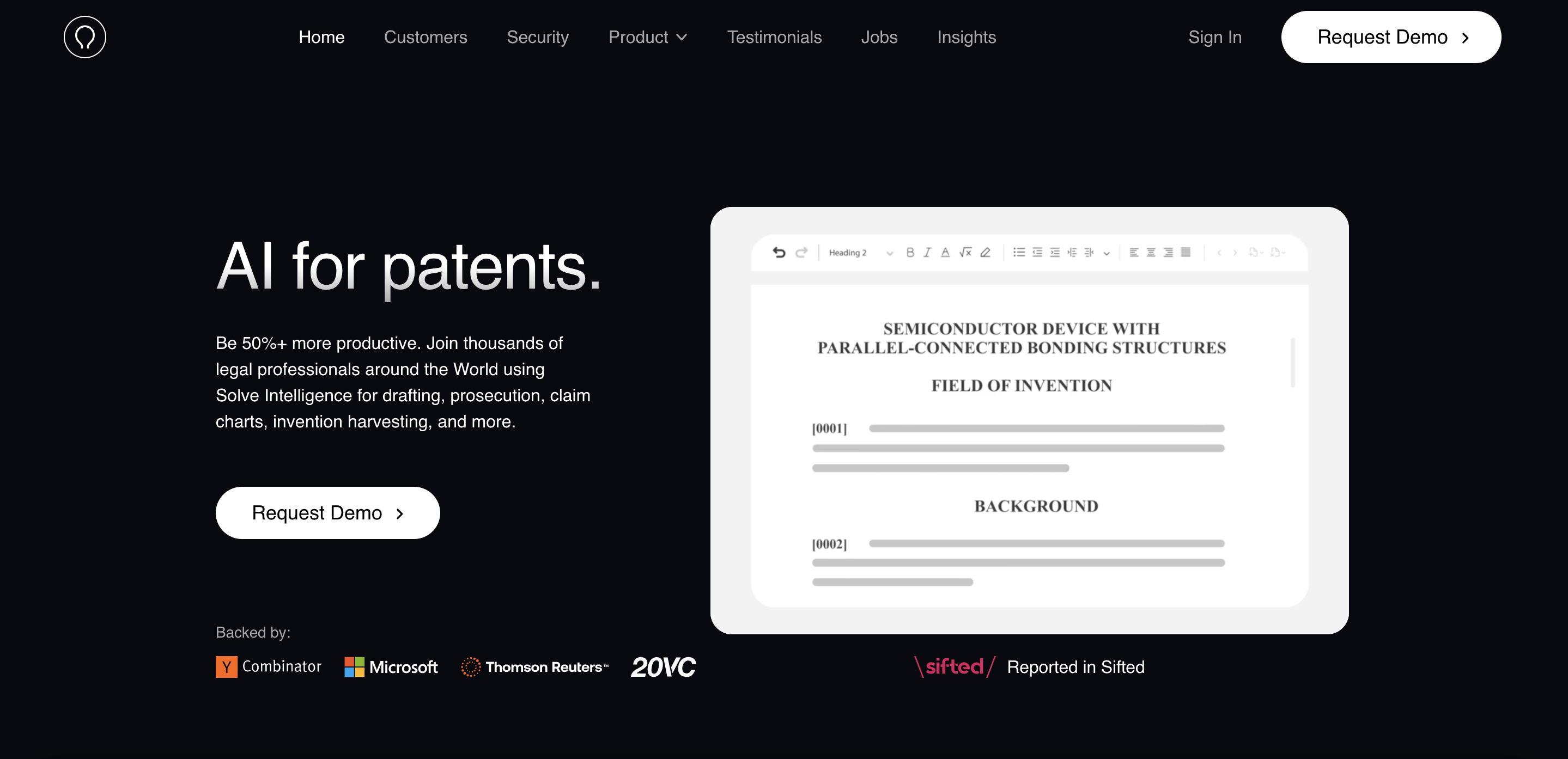
Solve Intelligence came out of Y Combinator's Summer 2023 batch and has moved quickly since. The company raised a $3M seed round shortly after launch, followed by a $12M Series A in April 2025 (backed by Microsoft's M12 and Thomson Reuters Ventures), and a $40M Series B in December 2025. It's now headquartered in both San Francisco and London, with offices opening in New York and Munich.
The founding team includes Chris Parsonson, Sanj Ahilan, and Angus Parsonson, all of whom come from machine learning research rather than patent law. Chris and Sanj both completed PhDs in machine learning at UCL, with prior experience at organizations like The Alan Turing Institute, Dyson, and Huawei.
That background shapes the product: Solve is built by AI researchers who saw patent drafting as ripe for automation and set out to build the most comprehensive toolset they could.
The result is a platform that tries to cover the entire patent lifecycle. From drafting to prosecution, invention harvesting to office action responses to claim charts, Solve wants to be the system of record for everything that touches a patent. Their pitch to large firms is essentially: adopt one platform and stop stitching together point solutions.
Patlytics
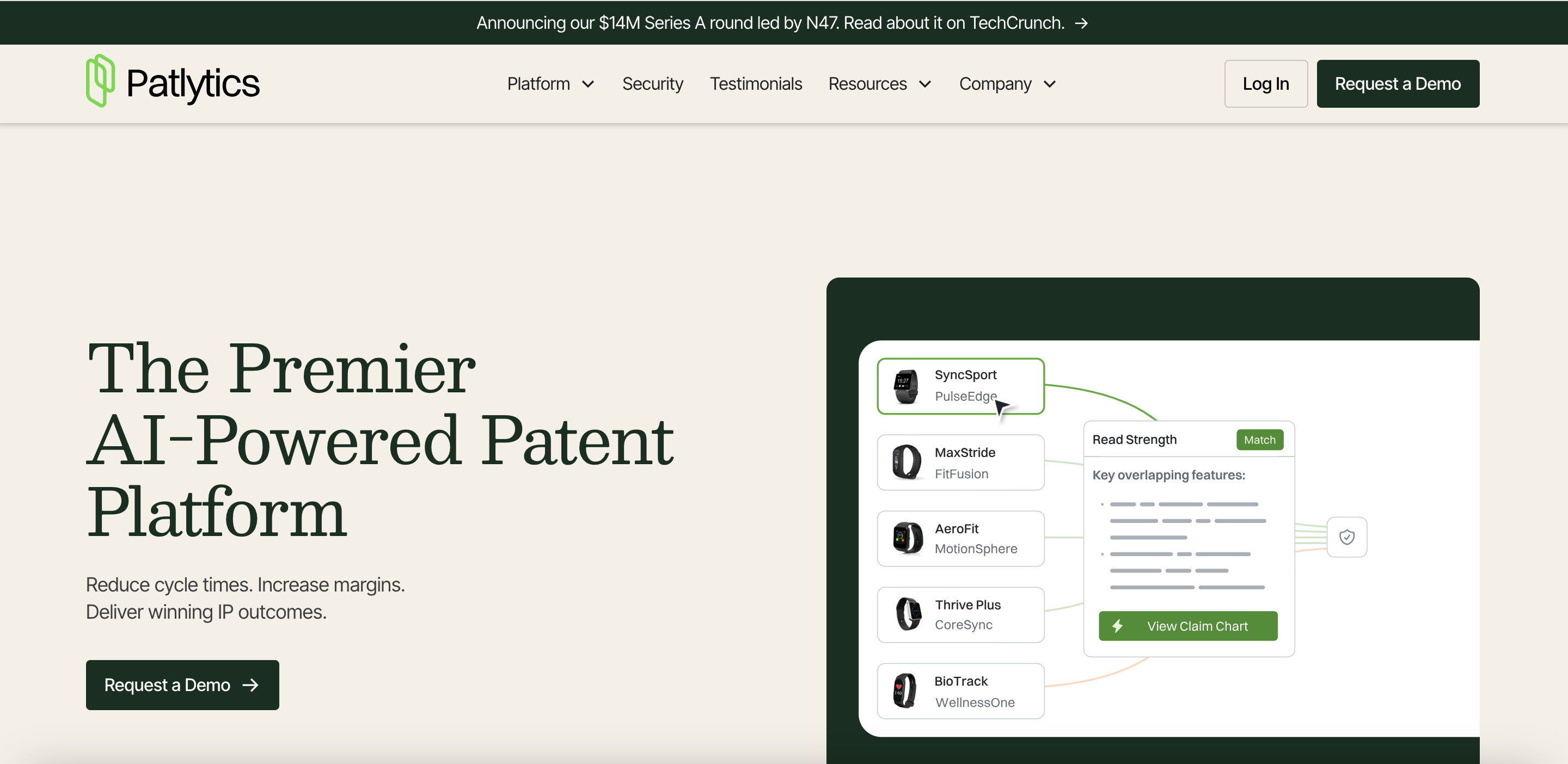
Patlytics is newer and has taken a different path. Founded in 2024 by Paul Lee and Arthur Jen, the company raised a $14M Series A in February 2025, led by Next47 (Siemens' venture arm) and Google's Gradient fund, bringing total funding to $21M. It's based in New York and has grown its customer base by 18x in six months, with clients including Quinn Emanuel, Google, Xerox, and Koch Disruptive Technologies.
Where Solve started with drafting and expanded outward, Patlytics started with patent intelligence and added drafting as one capability among many. The platform is built around litigation and portfolio analytics: infringement detection, claim charting, invalidity analysis, and SEP mapping.
Solve Intelligence vs. Patlytics: Core feature comparison
Drafting approach
Solve Intelligence is built around an in-browser document editor that feels similar to Google Docs. You upload a disclosure, and the AI helps you draft section by section (claims, specifications, abstracts, backgrounds) using a chat-based interface. You prompt the AI to "rewrite this claim," "expand this embodiment," or "add a paragraph on the control system," and it generates text you can accept, reject, or refine.
This approach gives practitioners significant control over where the AI steps in. You can use Solve lightly (occasional paragraph generation) or heavily (full application drafts from a disclosure). The platform supports standalone applications, continuations, divisionals, CIPs, and design patents, with templates tuned for USPTO and EPO filings. It also includes figure generation from text prompts; describe what you need, and the system produces diagrams you can edit and label.
Patlytics takes a more structured path. Rather than a freeform editor, the platform guides you through a workflow: upload your disclosure, structure your claim tree, generate claims, and then build out the specification. The AI does much of the heavy lifting automatically, with less back-and-forth prompting required. You're working within a system that has opinions about how drafting should proceed, which can feel either streamlined or constraining depending on your preferences.
AI interaction model
The difference in interaction models goes deeper than interface design. Solve's chat-based system means output quality depends significantly on how well you prompt. Experienced users report strong results, but there's a learning curve. Ultimately, getting consistent, high-quality output requires developing internal best practices around prompt structure and context-setting.
Patlytics abstracts more of that away. Because the workflow is more guided, there's less prompt engineering required, but also less room to customize exactly how the AI approaches a given section. The platform makes assumptions about what you need, which speeds things up when those assumptions are correct and creates friction when they're not.
There's a broader question here about what kind of AI assistance actually helps. Chat-based tools offer flexibility but push the burden of structure onto the user. Guided workflows reduce that burden but limit creative control. Neither approach is inherently superior; it depends on how much you want to direct the AI versus how much you want the AI to direct you.
This is one of the reasons we built Patentext around a different model entirely. Rather than generating text and asking you to evaluate it (Solve) or guiding you through a fixed workflow (Patlytics), Patentext maps the invention into a visual graph first. You see exactly how the AI has interpreted the disclosure (components, relationships, logic flows) before any drafting begins. The structure becomes explicit and editable, which means you're not prompting blindly or trusting a black-box workflow.
Prosecution and office actions
Solve Intelligence has invested heavily in prosecution tools. The platform can analyze office actions, suggest claim amendments, generate response shells, and cite relevant case law. In December 2025, Solve launched Charts, a new product for claim charting, invalidity analysis, and SEP mapping.
Patlytics, meanwhile, has offered these capabilities from the start. Infringement detection, evidence-of-use discovery, claim charting, and invalidity analysis are core to the platform. The drafting copilot exists alongside these tools, which means you can move from creating a patent to enforcing it without switching systems. For litigation-heavy practices or in-house teams managing large portfolios, this integration is a genuine advantage.
Invention disclosure and intake
Getting information out of inventors' heads and into a usable format is one of the most time-consuming parts of patent work. Both platforms have built tools to address this, though they approach it differently.
Solve Intelligence offers configurable disclosure questionnaires that guide inventors through the information-gathering process. You can customize the questions to match your practice's needs, and the platform tracks disclosure status and submissions across your organization. The goal is to standardize intake so that by the time a disclosure reaches the drafting stage, it's already structured in a useful way.
Patlytics focuses more on processing whatever materials already exist. The platform can audit external and internal source materials (including technical documents, PowerPoint decks, figures, images) and extract what's relevant for drafting. It also includes automated prior art searches and patentability assessments as part of the disclosure workflow, which helps teams triage ideas before committing drafting resources.
Solve Intelligence vs. Patlytics: Feature comparison
A checkmark (✓) means the feature is available. A dash (—) means the feature is not currently offered or not publicly confirmed.
Solve Intelligence vs. Patlytics: Pricing
Neither Solve Intelligence nor Patlytics publishes pricing on their websites, which is standard for enterprise legal tech but frustrating if you're a solo practitioner or small firm trying to figure out whether a tool is even in your budget before scheduling a sales call.
Solve Intelligence
Solve positions itself as an enterprise platform with flexible licensing. The company has mentioned that it offers different structures for solo practitioners versus large firms, but the details require a conversation with their sales team. Based on how the product is marketed, expect seat-based or usage-based models, likely with annual commitments and onboarding fees for larger deployments.
Patlytics
Patlytics similarly uses custom pricing based on organizational needs and scale. The platform is described as a "high-value SaaS" aimed at professional users who expect significant ROI from efficiency gains, and their customer list reinforces that this is a tool built for teams with budget, not individual practitioners testing the waters.
What this means for smaller teams
The opacity around pricing is a real barrier for practitioners who don't have time to sit through discovery calls just to learn whether a tool is affordable. Both Solve and Patlytics are optimized for enterprise sales cycles, which makes sense given their funding and growth targets, but leaves smaller firms underserved.
This is one of the reasons we built Patentext with transparent, volume-based pricing. Drafts start at $200 per patent application, with no seat minimums, annual contracts, or onboarding fees. You can file three applications one month and twelve the next without renegotiating a license.
We think pricing should be something you can evaluate in five minutes, not five meetings, but we also recognize that for large enterprises, Solve and Patlytics offer bundled capabilities that may justify their pricing models. If cost predictability matters to your practice, it's worth asking both Solve and Patlytics directly about their pricing structures for smaller teams before committing to extended evaluations.
Solve Intelligence vs. Patlytics: What each tool gets wrong
Comparison pages tend to focus on features and benefits, which makes sense: that's what most readers think they're looking for. But the more useful question is often: where does each tool create friction? What will frustrate you six months in that the marketing page didn't mention?
Solve Intelligence
Prompt dependency is real: Solve's flexibility is also its main liability. Because the platform relies on chat-based interaction, output quality varies significantly depending on how you phrase requests. Experienced users develop internal playbooks (prompt templates, context-setting routines, review checklists) that help them get consistent results. But that's work you have to do yourself, and it's not trivial. If you're expecting to upload a disclosure and get a polished draft back without much iteration, you'll be disappointed.
Mechanical and hardware inventions require more effort: Multiple user reviews note that Solve performs best on software and computer-implemented inventions. Mechanical patents, medical devices, and chemistry-heavy applications require more detailed prompts, back-and-forth, and cleanup.
Feature density can overwhelm: Solve covers drafting, prosecution, invention harvesting, office actions, and now claim charting. That's a lot of surface area. For large firms with dedicated teams, this breadth is valuable; for smaller practices, it can feel like paying for a Swiss Army knife when you needed a scalpel.
Patlytics
Drafting is a module, not the focus: Patlytics started as a patent intelligence platform and added drafting capabilities as the product expanded. That history shows. The drafting tools are competent, but they don't have the same depth or flexibility as platforms built around drafting from day one. If your primary need is high-quality application drafting and everything else is secondary, Patlytics may feel like overkill.
The guided workflow can feel constraining: Structure is helpful until it isn't. Patlytics' opinionated workflow reduces prompt engineering, but it also reduces your ability to draft in the order you prefer or deviate from the platform's assumptions. Practitioners with established drafting habits may find the rigidity frustrating.
Solve Intelligence vs. Patlytics: Who should use which tool
Choose Solve Intelligence if:
- Your practice handles complex, multi-jurisdictional patent work: Solve is built for firms that file across USPTO, EPO, and other offices and need jurisdiction-specific templates, terminology tuning, and workflow customization baked into one system.
- You value customization over guidance: Solve's chat-based interface lets you control exactly where the AI contributes. If you've developed strong drafting instincts and want an AI that adapts to your process rather than imposing its own, Solve offers that flexibility.
- You're primarily drafting software or computer-implemented inventions: If your docket is primarily non-software, factor in additional drafting time compared to what the marketing materials suggest.
- You have the budget and bandwidth for enterprise onboarding: Solve is a feature-rich platform that takes time to learn. Smaller teams may find themselves paying for features they don't need or spending time learning capabilities they won't use. But for firms ready to standardize their entire patent workflow on one system, that comprehensiveness becomes an asset rather than a liability.
Choose Patlytics if:
- Your work extends beyond drafting into enforcement, licensing, or portfolio strategy: Patlytics was built for teams that need to move fluidly between creating patents and using them. If you're regularly producing claim charts for litigation or evaluating portfolios for acquisition, having drafting integrated with those workflows eliminates the friction of switching tools.
- You want a more guided drafting experience: Patlytics' structured workflow reduces the prompt engineering required to get usable output. For practitioners who find chat-based AI frustrating or unpredictable, this approach can feel more efficient as long as you're comfortable working within the system's assumptions about how drafting should proceed.
- You're at a firm or company with budget for a comprehensive IP platform: This is enterprise software priced for enterprise buyers. If you're a solo practitioner or small boutique, the platform may offer more capability than you need at a price point that doesn't make sense for your volume.
- You need litigation-ready output from day one: Because Patlytics connects drafting to downstream enforcement tools, applications drafted in the platform are already structured for claim charting and infringement analysis. If you know a patent is likely to be asserted or licensed, building it within a system designed for that lifecycle has real advantages.
If neither the chat-based flexibility of Solve nor the guided workflow of Patlytics feels quite right, consider Patentext instead. Once you upload your disclosure, the platform maps your invention into a visual graph that breaks down components, steps, logical relationships, and variants. You can see exactly how the AI has interpreted the invention, edit the structure directly, and then use Patentext to generate draft sections that stay consistent with that shared understanding.
The result is less time spent prompting, less time reviewing incoherent output, and more confidence that the draft reflects the actual invention. This approach works particularly well for complex inventions where logical structure matters more than raw output speed, and for practitioners who want transparency into what the AI is doing rather than a black box they have to trust.
Patentext is also built for smaller teams who value transparent pricing, no enterprise sales cycles, and workflows designed for practitioners who draft patents themselves rather than managing teams who do.
Request a free, 4-week firm pilot.
Frequently asked questions
Does Solve Intelligence offer a free trial?
Solve Intelligence does not publicly advertise a free trial. The company uses an enterprise sales model, so you'll need to schedule a demo and speak with their team to discuss pricing, pilots, and evaluation options.
Does Patlytics offer a free trial?
Patlytics also uses custom pricing and an enterprise sales process. Like Solve, you'll need to contact their team directly to explore trial options or pilot programs.
Is Solve Intelligence or Patlytics easier to learn?
It depends on what you're used to. Patlytics offers a more guided workflow with less prompt engineering required, which can make initial onboarding faster for practitioners who find chat-based AI frustrating. Solve Intelligence offers more flexibility but requires developing internal practices around prompting and review to get consistent results.
Is Solve Intelligence or Patlytics better for software patents (versus mechanical patents)?
User reviews suggest Solve Intelligence performs best on software and computer-implemented inventions, with mechanical patents requiring more manual input and iteration. Patlytics doesn't have the same volume of public feedback on technology-specific performance, but its structured workflow may help with consistency across patent types.
Can I use Solve Intelligence for EPO filings?
Yes. Solve Intelligence supports jurisdiction-specific templates and formatting for both USPTO and EPO filings. The platform also offers customization for other patent offices, though USPTO and EPO appear to have the most developed support.
Does Patlytics integrate with Microsoft Word?
Patlytics is primarily a web-based platform. You can export drafts to Word, but the tool doesn't offer a native Word plugin or add-in like some other patent drafting tools. If working directly in Word is central to your workflow, this is worth considering.
Is Solve Intelligence or Patlytics better for office action responses?
Both platforms offer prosecution support, but they emphasize different aspects. Solve Intelligence provides office action analysis, amendment suggestions, response shell generation, and case law citation. Patlytics includes office action support as part of its broader platform, with tighter integration to infringement and invalidity analysis. If prosecution is your primary need, Solve's tools may feel more developed; if you need prosecution connected to litigation workflows, Patlytics offers that integration.
How does pricing compare between Solve Intelligence and Patlytics?
Neither company publishes pricing publicly. Both use enterprise sales models with custom pricing based on team size, usage, and organizational needs. Based on their positioning and customer profiles, expect premium pricing aimed at larger firms and corporate IP teams.
Who has better security or compliance: Solve Intelligence or Patlytics?
Both Solve Intelligence and Patlytics meet enterprise security standards. Solve is SOC 2 certified and holds ISO 42001 certification, with options for data residency in the US or Europe. Patlytics is SOC 2 certified with a 99.5% uptime SLA and enterprise-grade encryption.
Disclaimer: This article is for informational purposes only and does not constitute legal advice. Patent laws are complex and vary by jurisdiction. For personalized guidance, consult a qualified patent attorney or agent.