Services

Turn filing-ready inventions into patent applications

Patentext Services provides flat-fee patent application services through USPTO-registered patent agents, building directly from the invention context your team captures in the Patentext platform.

Patentext Services

Patent application services connected to your platform workflow

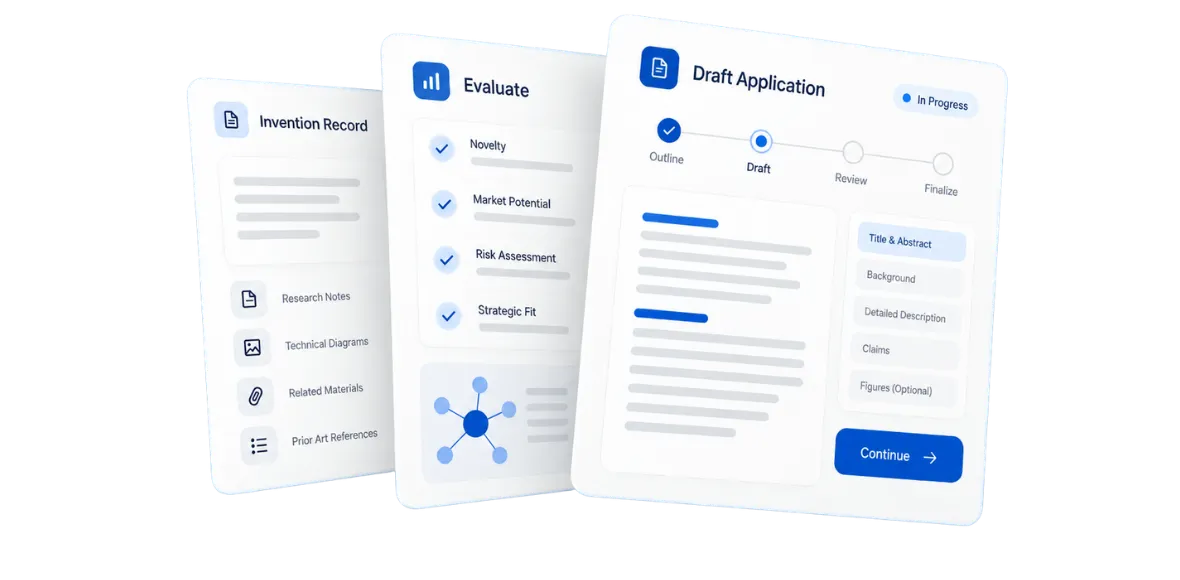
Patentext Services extends the platform workflow when an invention is ready to become a patent application.

01

Capture

The Patentext platform organizes the invention's technical details, alternatives, references, and filing rationale before drafting begins.

02

Draft

USPTO-registered patent agents use the invention record your team already built in the platform to draft the application in days, rather than weeks.

03

Review

Drafts, questions, revisions, and supporting context stay connected inside the platform, giving your team more visibility and less back-and-forth.

04

File

When the application is ready, Patentext Services helps prepare and file it with the USPTO. After filing, your team can track application status and related portfolio activity from the Patentext platform dashboard.

Patent drafting without the law firm drag

Patentext Services keeps experienced patent professionals in control while removing the delays, repeated context gathering, and unpredictable costs that make traditional drafting harder than it needs to be.

Drafted in days, not weeks

Because each application starts from structured invention context, Patentext reduces the manual intake and reconstruction work that slows down traditional drafting.

50%+ more affordable than traditional law firm drafting

Our software-first workflow lowers the cost of preparing high-quality patent applications, making it easier to build a strategic portfolio without traditional law firm overhead.

Less back-and-forth for your team

The invention graph keeps the technical problem, solution, implementation details, alternatives, and filing rationale connected from the start.

Drafted by patent agents, not AI alone

Patentext applications are drafted by USPTO-registered patent agents. AI helps accelerate the workflow, but experienced practitioners guide the structure, quality, and filing readiness of each application.

What we help you draft and file

Patentext Services supports the full path from filing-ready invention to submitted application, continuation strategy, and prosecution.

New Patent Filings
01

New patent filings

Move from structured invention context to a drafted and filed patent application, whether you are securing an early filing date or preparing a full utility application.

Includes

Continuations and portfolio expansion

Extend protection around important product improvements, additional claim scope, continuation opportunities, or new commercial priorities as your technology evolves.

Includes
  • Continuation applications ($2,000)
  • Additional claim strategy
  • Portfolio review and filing prioritization
  • Follow-on filings tied to product or market developments
02
Continuations And Portfolio Expansion
Prosecution
03

Prosecution

Keep applications moving through examination with technically grounded responses, amendments, and filing support.

Includes
  • Office action responses ($2,000)
  • RCEs with office action responses ($2,600)
  • Restriction requirement responses ($750)
  • Notice of allowance and issue fee support ($850)

A different model for patent services

Traditional
law firm
Boutique patent
agency
Self-serve
AI
Patentext
Services
Affordable, predictable pricing
Fast first draft
High-quality application draft
Patent-agent drafted
Easy review with less back-and-forth
Help filing with the USPTO
Easy tracking after filing

Frequently asked questions

Who drafts Patentext applications?

All Patentext patent applications are prepared by USPTO-registered patent agents. The Patentext platform supports invention capture and drafting, but the registered practitioner directs the work and remains responsible for the application.

Is Patentext a law firm?

No. Patentext Services is a registered patent agency, not a law firm. Patentext does not provide legal advice. Patent agents are authorized to prepare and prosecute patent applications before the USPTO. If your situation requires legal advice beyond USPTO patent practice, you should consult a licensed attorney.

Are USPTO filing fees included?

Yes. Standard USPTO filing fees for qualifying small-entity matters are included in the service fee for both provisional and non-provisional applications. Additional or non-standard fees — such as excess claim fees or excess page fees — are not included and would be communicated in advance.

Is the Patentext platform required?

Yes. Patentext Services are delivered through the Patentext platform. A paid Discovery plan, starting at $30/month, is required while your application is active. The platform gives your team and the assigned patent agent one connected place to manage invention intake, review the application draft, and track filing deadlines.

Can we start with one application?

Yes. There is no minimum commitment. Many companies start with a single provisional or non-provisional application and expand their use of Patentext as more inventions move through the pipeline.

Can Patentext work with our existing counsel?

Yes. Your company can use Patentext for specific filings, invention capture, drafting support, or portfolio overflow while continuing to work with existing counsel on other matters. Responsibilities should be clearly defined before work begins.

How long does drafting take?

Patentext's workflow is designed to prepare filing-ready applications in days rather than weeks. The exact timeline depends on the complexity of the invention, the completeness of the technical information your team provides, and current practitioner capacity. If you have an upcoming deadline, let Patentext know early so the schedule can be planned accordingly.

What information does our team need to provide?

Patentext's guided intake collects the technical details the patent agent needs to prepare the application — including how the invention works, its key components or steps, what makes it different from existing approaches, and any known alternatives or variations. You do not need legal language or a finished product; plain technical descriptions are the starting point. The platform structures this information before drafting begins.

Ready to file your next application?